TL;DR: Off-Grid vs Grid-Tied Solar comes down to balancing energy independence, reliability, and cost. For most UK homeowners, a grid-tied or hybrid system provides the best combination of lower energy bills and dependable power, while fully off-grid systems require larger solar arrays, significant battery storage, and a higher investment to achieve complete self-sufficiency.
When most people think about going solar, they think about panels, their type, how many, and where they go on the roof.
But there’s a bigger decision sitting underneath all of that, and it shapes everything from your upfront cost to how your home actually runs day to day. It’s the question of whether your system connects to the national grid or goes it alone.
Get this right, and solar works brilliantly. Get it wrong, and you could end up with a system that’s either more expensive than it needs to be or doesn’t deliver the independence you were hoping for.
What Actually Happens When Your Panels Aren’t Generating?
This is the question worth starting with. Solar panels produce electricity when the sun’s out. Evenings, overnight, overcast days in December, none of those run on solar. So, what fills the gap?
In a grid-tied system, the answer is simple: the national grid. When your panels produce more than you’re using, the surplus goes to the grid. When they’re not producing enough, power flows back in automatically.
In an off-grid system, there’s no grid connection at all. Your backup is your batteries. Once those run out, unless you’ve got a generator, you’re without power. That’s a very different situation, and it requires a very different approach to the system design.
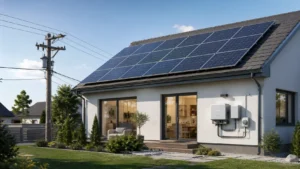
Grid-Tied Solar: How It Works Day to Day
Grid-tied is by far the most common setup in the UK, and it’s easy to see why. It’s simpler to install, cheaper to buy, and gives you constant peace of mind. You’ll never run out of electricity, because the grid is always there.
During the day, your solar panels generate electricity, and your home uses it directly. Whatever you’re not using at that moment gets exported to the grid, and under the Smart Export Guarantee, your energy supplier pays you a rate for every unit you send.
There is one catch worth knowing about. If there’s a power cut, most grid-tied systems will automatically switch off your solar panels as a safety measure, even if they’re generating. That means you lose power along with everyone else on the street.
Off-Grid Solar: What It Really Takes
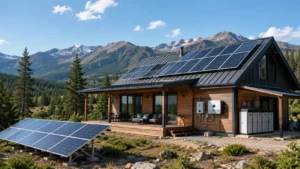
Off-grid sounds appealing. Total freedom, no energy bills, no dependence on suppliers. And for the right property, it genuinely is the right answer. But it’s not cheap, and it’s not simple.
To run off-grid reliably through a UK winter, your system needs to generate and store enough energy to cover your household through the worst stretches – think several overcast days in a row in January. That means a significantly larger solar array than most grid-tied homes would bother with, a battery bank with enough capacity to last multiple days, and in most cases, a backup generator for when it all gets too grey for too long.
The cost reflects this. A grid-tied system for a typical UK home might come in at £6,000 to £10,000, depending on size. A properly spec’d off-grid system, one that won’t leave you in the dark in winter, can easily run to two or three times that.
Off-grid makes real sense for remote or rural properties where a grid connection would be expensive or impractical, and for homeowners who genuinely want full independence regardless of cost.
The Hybrid Sweet Spot
For the majority of UK homeowners, the best answer isn’t at either extreme. It’s a grid-tied system with battery storage, often called a hybrid system, and it’s become increasingly popular for good reason.
Here’s how it works: during the day, your panels generate electricity. Your home uses what it needs. Any surplus charges your battery. In the evening, you run off the battery rather than the grid. If you drain the battery, the grid kicks in as normal. You’re not off-grid, but you’re not drawing much from the grid either.
Some hybrid systems can also be set up to provide backup power during outages, something a basic grid-tied system can’t do. And with battery costs falling significantly over the last few years, the numbers are starting to make more sense than they used to.
How to Actually Choose Between Off-grid vs On-Grid Solar System
Here’s a straightforward way to think about it.
If you mainly want lower bills and you’re on the grid, start with a grid-tied system. Add battery storage if you want to maximise how much of your own solar you use. You’ll get a strong financial return, and you’ll never have to worry about power.
If independence matters to you, not just saving money, but genuinely reducing your reliance on suppliers, a hybrid system is probably the right call. You’ll cover most evenings and overnight from stored solar, cut your grid use substantially, and still have the security of the grid in reserve.
If you’re off-grid already, in a remote location, or simply want complete self-sufficiency as a priority, off-grid can absolutely work. Just go in with a realistic picture of what winter looks like for your area, size accordingly, and don’t underestimate how much storage you’ll need.
One Mistake to Avoid
A lot of people choose their system based on what looks good on an annual average.
But a system that covers your yearly energy use on paper might still leave you leaning heavily on the grid from October through February. If independence is the goal, think about December, not June.
The right system is the one that matches your life, your actual budget, and your home’s location. Understanding Off-Grid vs Grid-Tied Solar helps ensure you make the most informed decision.
Off-Grid vs Grid-Tied Solar FAQs
Is battery storage essential for a hybrid solar system?
Battery storage is what makes a hybrid system different from a standard grid-tied setup. While it increases the upfront cost, it allows you to store excess solar energy for use during the evening, helping to reduce reliance on the grid.
Can a grid-tied solar system be upgraded with batteries later?
Yes, many homeowners start with a grid-tied system and add battery storage later. This can spread the installation cost over time while still allowing you to increase your energy independence in the future.
How much battery capacity is needed for an off-grid home?
The amount of battery storage required depends on your energy usage and how many days of backup power you want. Off-grid systems in the UK often need enough storage to cover several days of low solar generation during winter.
Do solar panels produce enough electricity during the UK winter?
Solar panels continue to generate electricity during winter, but shorter days and lower sunlight levels reduce output significantly. This is why system sizing should consider winter performance rather than annual averages alone.
What happens to excess electricity in an off-grid solar system?
Once the batteries are fully charged, any additional electricity generated by the panels cannot be exported to the grid and may go unused. Proper system design helps balance generation, storage capacity, and household demand.